The Kremlin
A fifteenth-century fortress on the Moskva River, the working seat of the President of Russia, and the ledger of the five presidencies held since 1991.
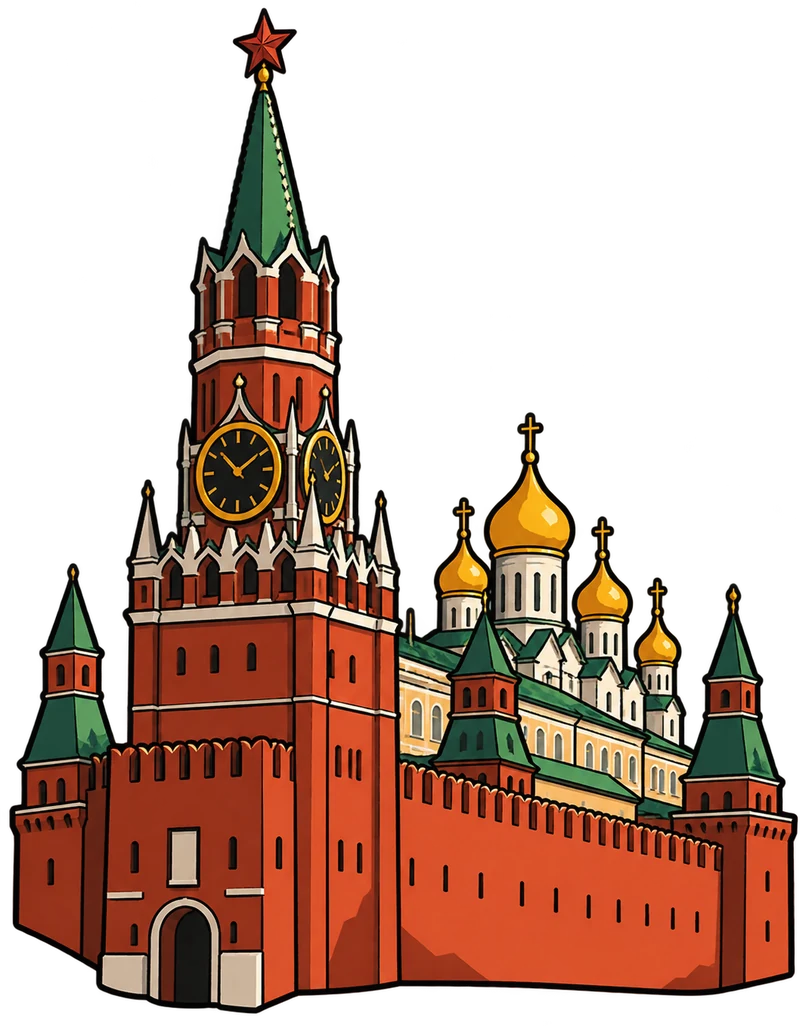
The Kremlin is a walled fortress on a hill above the Moskva River, in the center of Moscow. "Kremlin" is the Russian word for a citadel, and many old Russian cities have one. This is the one the word now means. The President of Russia works inside it, in the Senate building on its northern side.
| Building | Kremlin |
|---|---|
| What Wikidata calls it | kremlin |
| Capital | Moscow |
| Form of government | semi-presidential federation |
| Population | 146,119,928 |
The building
There has been a fortified settlement on the hill since at least the twelfth century. The brick walls and towers that stand today were built between 1485 and 1495, when Grand Prince Ivan III brought architects from Italy to rebuild the older white-stone walls. The walls run for about two and a quarter kilometers, with twenty towers. The cathedrals inside the walls, where the tsars were crowned and buried, were built in the same period.
The Senate building, a yellow triangle with a green dome, was designed by Matvei Kazakov and finished in 1787, under Catherine the Great. The capital moved to St Petersburg in the early eighteenth century and returned to Moscow in March 1918, and the Kremlin again became the seat of government. The Soviet leadership worked there for more than seventy years, and the Russian presidency took it over when the Soviet Union ended in 1991.
Who held the office
The presidency of Russia was created in 1991. The ledger records 5 presidential terms held by 4 people.
- Boris Yeltsin was elected in June 1991 and took office on 10 July, while the Soviet Union still existed. He resigned on 31 December 1999.
- Viktor Chernomyrdin appears for a single day, 5 to 6 November 1996, while Yeltsin was under anaesthetic for heart surgery. The source records it as a transfer of the office.
- Vladimir Putin became acting president on Yeltsin's resignation. The source starts his first term at his inauguration on 7 May 2000 and does not record the acting months as a separate row.
- Dmitry Medvedev served one term, from 2008 to 2012, while Putin was prime minister.
- Putin returned in 2012 and holds the office now.
| # | Held by | From | To | Party |
|---|---|---|---|---|
| 4 | Vladimir Putin | May 7, 2012 | incumbent | |
| 3 | Dmitry Medvedev | May 7, 2008 | May 7, 2012 | |
| 2 | Vladimir Putin | May 7, 2000 | May 7, 2008 | |
| Victor Chernomyrdin | November 5, 1996 | November 6, 1996 | ||
| 1 | Boris Yeltsin | July 10, 1991 | December 31, 1999 |
5 tenures. Source: Wikidata, retrieved 2026-09-23.
Two seats, one person
Russia has a president and a prime minister, and the ledger holds both lineages. Read together, they show something neither shows alone. Vladimir Putin became prime minister on 9 August 1999. Since then he has held one of the two offices at every point: prime minister, then president, then prime minister again from 2008, then president from 2012.
| # | Held by | From | To | Party |
|---|---|---|---|---|
| Andrei Belousov | April 30, 2020 | May 19, 2020 | ||
| Mikhail Mishustin | January 16, 2020 | incumbent | ||
| Dmitry Medvedev | May 8, 2012 | January 16, 2020 | ||
| 38 | Vladimir Putin | May 8, 2008 | May 7, 2012 | |
| Viktor Zubkov | September 14, 2007 | May 7, 2008 | ||
| Mikhhail Fradkov | March 5, 2004 | September 14, 2007 | ||
| Victor Khristenko | February 24, 2004 | March 5, 2004 | ||
| Mikhail Kasianov | May 7, 2000 | February 24, 2004 | ||
| 34 | Vladimir Putin | August 16, 1999 | May 7, 2000 | |
| Vladimir Putin | August 9, 1999 | August 16, 1999 | ||
| Sergei Stepashin | May 12, 1999 | August 9, 1999 | ||
| Evgeny Primakov | September 11, 1998 | May 12, 1999 | ||
| Victor Chernomyrdin | August 24, 1998 | September 11, 1998 | ||
| Sergei Kirienko | March 23, 1998 | August 23, 1998 | ||
| Victor Chernomyrdin | December 14, 1992 | March 23, 1998 | ||
| Egor Gajdar | June 15, 1992 | December 15, 1992 | ||
| Boris Yeltsin | November 6, 1991 | June 15, 1992 | ||
| Alexander Kerensky | July 21, 1917 | November 7, 1917 | ||
| Georgy Lvov | March 2, 1917 | July 7, 1917 | ||
| Nicholas Golitsyn | December 27, 1916 | February 27, 1917 | ||
| Alexander Trepov | November 10, 1916 | December 27, 1916 | ||
| Boris Stürmer | January 20, 1916 | November 10, 1916 | ||
| Ivan Goremykin | January 31, 1914 | January 20, 1916 | ||
| Vladimir Kokovtsov | September 9, 1911 | January 30, 1914 | ||
| Pyotr Stolypin | July 21, 1906 | September 5, 1911 | ||
| 2 | Ivan Goremykin | April 22, 1906 | July 8, 1906 | |
| Sergei Witte | November 6, 1905 | May 5, 1906 | ||
| Adam Czartoryski | January 1, 1804 | January 1, 1806 |
28 tenures. Source: Wikidata, retrieved 2026-09-23.
The prime minister's lineage in the source begins before the Soviet period, with the chairmen of the imperial Council of Ministers from 1905. It then jumps to 1991, because the Soviet heads of government are recorded under a different office. The earliest entry, Adam Czartoryski in 1804, held a different post and is under review.
Last updated September 22, 2026.