The Alvorada and Planalto palaces
Brazil built a capital from nothing in the 1950s and gave its president two palaces by Oscar Niemeyer, one to live in and one to work in. The ledger of every president since 1889.
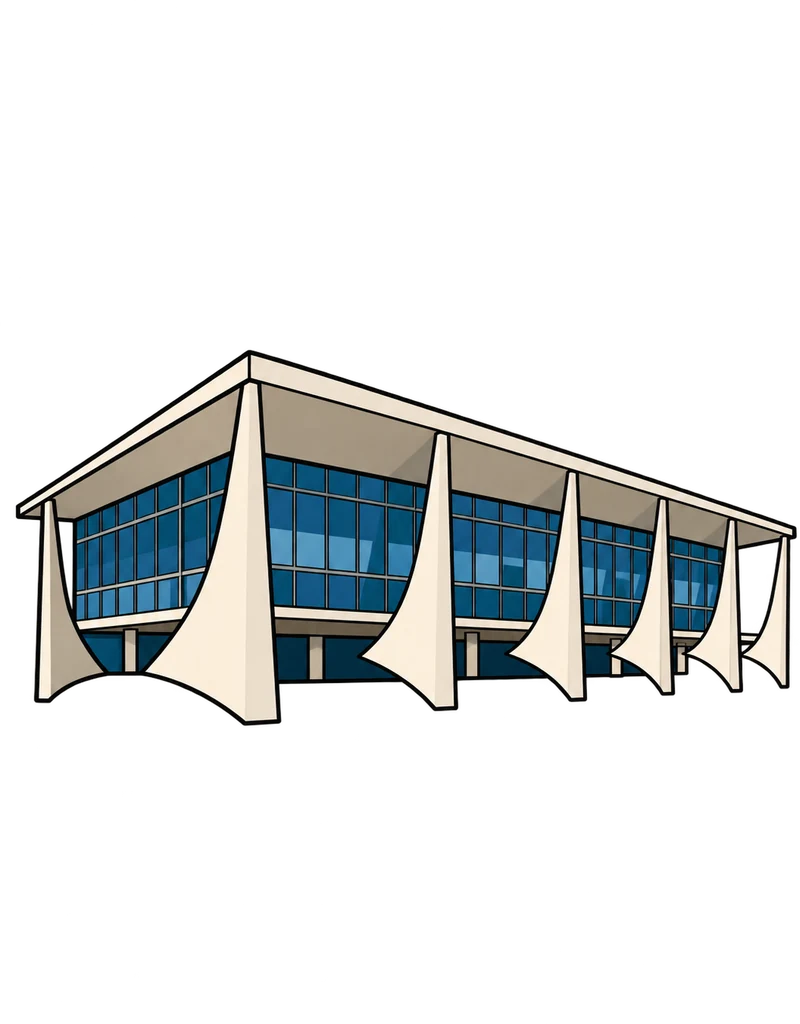
Brazil's president lives in one palace and works in another. The Palácio da Alvorada, the "Palace of the Dawn," is the residence, on a peninsula in Lake Paranoá. The Palácio do Planalto, the "Palace of the Plateau," is the office, on the Square of the Three Powers, facing the National Congress and the Supreme Federal Court. The architect Oscar Niemeyer designed both, and both are only a few years older than the city itself.
| Building | Palácio da Alvorada |
|---|---|
| What Wikidata calls it | palace |
| Capital | Brasília |
| Form of government | federal presidential republic |
| Population | 214,211,951 |
The capital that was built for them
For almost two centuries Brazil was governed from Rio de Janeiro, on the coast. The first republican constitution, in 1891, called for a capital in the interior, but the move waited until President Juscelino Kubitschek, who built Brasília in less than four years. The plan was by Lúcio Costa, and the major buildings were by Niemeyer.
The Alvorada was the first major building to be finished, in 1958. Its thin, curving marble columns became the symbol of the new city, and they appear on the city's coat of arms. Brasília was inaugurated on 21 April 1960, and the Planalto opened the same day. From the Planalto's ramp the president can walk across the square to the Congress, which is part of the design's point: the three branches of government face each other.
Who held the office
The republic was proclaimed on 15 November 1889, when Marshal Deodoro da Fonseca overthrew the emperor Pedro II. The ledger records 42 presidential terms since then, held by 36 people.
Luiz Inácio Lula da Silva appears 3 times: two consecutive terms from 2003 to 2010, and a third from 2023. Dilma Rousseff's second term ends on 31 August 2016, the day the Senate removed her from office after impeachment. Her vice president, Michel Temer, served the remainder.
| # | Held by | From | To | Party |
|---|---|---|---|---|
| 44 | Luiz Inácio Lula da Silva | January 1, 2023 | incumbent | |
| 43 | Jair Bolsonaro | January 1, 2019 | January 1, 2023 | |
| 42 | Michel Temer | August 31, 2016 | January 1, 2019 | |
| 41 | Dilma Rousseff | January 1, 2015 | August 31, 2016 | |
| 40 | Dilma Rousseff | January 1, 2011 | December 31, 2014 | |
| 39 | Luiz Inácio Lula da Silva | January 1, 2007 | January 1, 2011 | |
| 38 | Luiz Inácio Lula da Silva | January 1, 2003 | January 1, 2007 | |
| 37 | Fernando Henrique Cardoso | January 1, 1999 | January 1, 2003 | |
| 36 | Fernando Henrique Cardoso | January 1, 1995 | January 1, 1999 | |
| 35 | Itamar Franco | December 29, 1992 | January 1, 1995 | |
| 34 | Fernando Collor | March 15, 1990 | October 2, 1992 | |
| 33 | José Sarney | March 15, 1985 | March 15, 1990 | |
| 32 | João Figueiredo | March 15, 1979 | March 15, 1985 | |
| 31 | Ernesto Geisel | March 15, 1974 | March 15, 1979 | |
| 30 | Emílio Garrastazu Médici | October 30, 1969 | March 15, 1974 | |
| 28 | Artur da Costa e Silva | March 15, 1967 | August 31, 1969 | |
| 27 | Humberto Castelo Branco | April 15, 1964 | March 15, 1967 | |
| 26 | Pascoal Ranieri Mazzilli | April 2, 1964 | April 15, 1964 | |
| 25 | João Goulart | September 8, 1961 | April 1, 1964 | |
| 24 | Pascoal Ranieri Mazzilli | August 25, 1961 | September 7, 1961 | |
| 23 | Jânio Quadros | January 31, 1961 | August 25, 1961 | |
| 22 | Juscelino Kubitschek | January 31, 1956 | January 31, 1961 | |
| 21 | Nereu Ramos | November 11, 1955 | January 31, 1956 | |
| 20 | Carlos Luz | November 9, 1955 | November 11, 1955 | |
| 19 | Café Filho | August 24, 1954 | November 8, 1955 | |
| 18 | Getúlio Vargas | January 31, 1951 | August 24, 1954 | |
| 17 | Eurico Gaspar Dutra | January 31, 1946 | January 31, 1951 | |
| 16 | José Linhares | October 29, 1945 | January 31, 1946 | |
| 15 | Getúlio Vargas | November 3, 1930 | October 29, 1945 | |
| 13 | Washington Luís | November 15, 1926 | October 24, 1930 | |
| 12 | Artur Bernardes | November 15, 1922 | November 15, 1926 | |
| 11 | Epitácio Pessoa | July 28, 1919 | November 15, 1922 | |
| 10 | Delfim Moreira | November 15, 1918 | July 28, 1919 | |
| 9 | Venceslau Brás | November 15, 1914 | November 15, 1918 | |
| 8 | Hermes da Fonseca | November 15, 1910 | November 15, 1914 | |
| 7 | Nilo Peçanha | June 14, 1909 | November 15, 1910 | |
| 6 | Afonso Pena | November 15, 1906 | June 14, 1909 | |
| 5 | Francisco de Paula Rodrigues Alves | November 15, 1902 | November 15, 1906 | |
| 4 | Manuel Ferraz de Campos Sales | November 15, 1898 | November 15, 1902 | |
| 3 | Prudente de Morais | November 15, 1894 | November 15, 1898 | |
| 2 | Floriano Peixoto | November 23, 1891 | November 15, 1894 | |
| 1 | Deodoro da Fonseca | November 15, 1889 | November 23, 1891 |
42 tenures. Source: Wikidata, retrieved 2026-09-23.
How the office is filled
Brazil is a presidential republic, and the president is both head of state and head of government. The president is elected directly for four years, with a runoff if no candidate wins a majority in the first round, and may serve two consecutive terms. The limit applies to consecutive terms only, which is how Lula could return in 2023.
Last updated September 22, 2026.